
Warning signs indicate danger. They are normally used only where the danger is difficult for road users to foresee, or where it is significantly greater than they might reasonably expect.
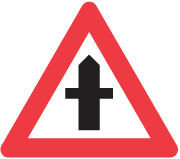
There is a dangerous junction ahead. Crossing traffic from the side road must give way. A T junction on one side is shown by the symbol.
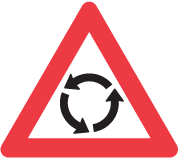
Roundabout.
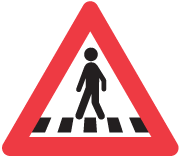
In connection with the plate below with the text »Pedestrian street«, the sign will indicate a crossing pedestrian street.
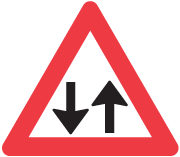
Besides at the normal distance, see Section 11, the sign can be set up at the beginning of a stretch with oncoming traffic.
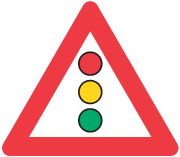
Traffic light.
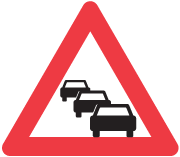
The road sign indicates a particular risk of congestion.
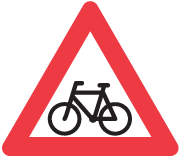
The sign indicates particular danger where cyclists and drivers of small mopeds drive out onto the traffic lane or cross it.
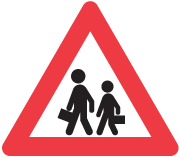
The sign indicates a particular danger, where children are on or beside the road. The sign can be used to demarcate that a school patrol is working. In these cases, the sign is supplemented below with a plate sign with the text »School«. In places without a signalling system or without a pedestrian crossing, two flashing yellow lights must be installed above the warning sign.
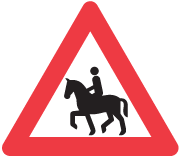
Horse riders may be on or near the carriageway.
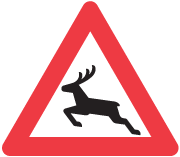
Symbols can be used on the sign, which show other animals.
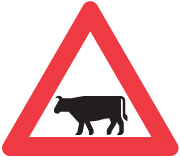
Symbols can be used on the sign, which show other animals.
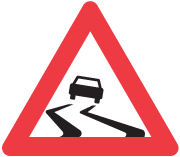
The sign indicates that the road surface may be unusually slippery. The reason is shown on the supplementary plate below, for example “Slippery when wet”.
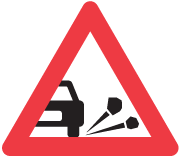
The road sign indicates a particular risk of stone impact.
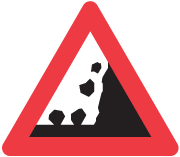
The sign indicates a particular risk of rock slide and for fallen rocks.
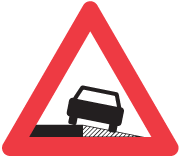
The reason may be shown on a supplementary plate below, for example “Soft verge” or “High edge”. The sign may be placed at the normal distance from the hazard or at the beginning of the hazardous stretch. It may be reversed as required.
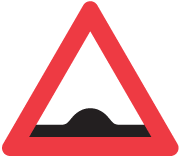
The sign indicates speed-reducing bump on the road.
If the warning only applies to users of cycle tracks or pedestrians on the pavement, this is indicated on the plate below the sign.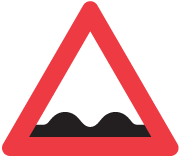
The sign warns of an uneven road surface ahead..
If the warning only applies to road users on a cycle path or the pavement, this is shown on a supplementary plate below the sign.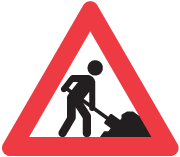
If the warning only applies to road users on cycle paths or the pavement, this is indicated on the plate below the sign.
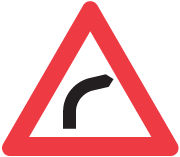
Right bend. The sign indicates dangerous bends in the road. Where the sign is used to warn about more than two bends, the length of the stretch or the number of bends is indicated on the plate below the sign.
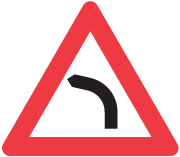
Left bend. The sign indicates dangerous bends in the road. Where the sign is used to warn about more than two bends, the length of the stretch or the number of bends is indicated on the plate below the sign.
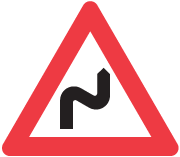
Several bends, the first one is to the right. The sign indicates dangerous bends in the road. Where the sign is used to warn about more than two bends, the length of the stretch or the number of bends is indicated on the plate below the sign.
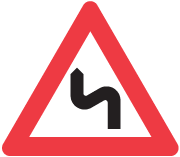
Several bends, the first one is to the left. The sign indicates dangerous bends in the road. Where the sign is used to warn about more than two bends, the length of the stretch or the number of bends is indicated on the plate below the sign.
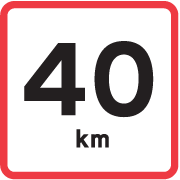
The plate under the sign indicates the speed at which the bend or bends can be driven through under normal conditions.
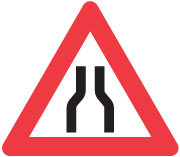
Narrowing road. If the warning only applies to users of cycle tracks this is indicated on the plate below the sign.
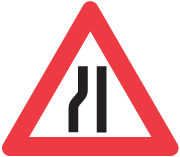
Narrowing road on left side. If the warning only applies to users of cycle tracks this is indicated on the plate below the sign.
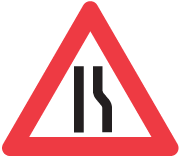
Narrowing road on right side. If the warning only applies to users of cycle tracks this is indicated on the plate below the sign.
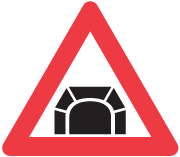
The length of and name of the tunnel can be indicated on the plate below the sign.
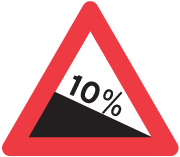
Warning of a steep downhill gradient ahead. The percentage indicates the maximum gradient.
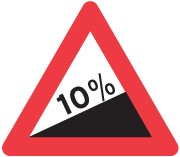
Warning of a steep uphill gradient ahead. The percentage indicates the maximum gradient.
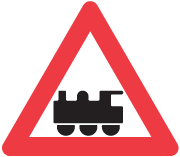
The plate, UB 11.1 Advance Warning of Stop, below the sign is used to warn of a stop by a railway crossing. The distance to the railway crossing is indicated on the plate under the sign.
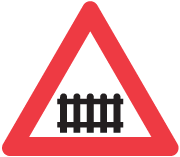
Railway crossing with barrier.

Level crossing sign for single-lane railway crossing. The signs are set up immediately in front of the railway crossing. The sign, B 13 Stop, and plate below, UA 72, can be set up under the level crossing sign.
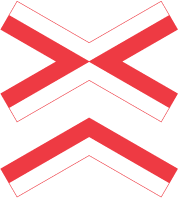
Level crossing sign for multi-lane railway crossing. The signs are set up immediately in front of the railway crossing. The sign, B 13 Stop, and plate below, UA 72, can be set up under the level crossing sign.
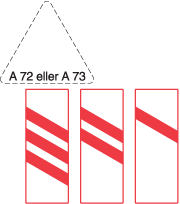
The signs indicate the distance to the railway crossing. They are used in connection with sign A 72 and A 73 on roads with considerable and fast moving traffic. Thus, the signs are not normally used on roads where the permitted speed is 60km/h or lower. The sign with three diagonal stripes are set up under sign A 72 or A 73 and signs with two diagonal stripes and one diagonal stripe are set up so they indicate two-thirds and one-third of the distance to the crossing.
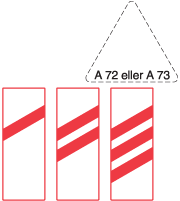
The signs indicate the distance to the railway crossing. They are used in connection with sign A 72 and A 73 on roads with considerable and fast moving traffic. Thus, the signs are not normally used on roads where the permitted speed is 60km/h or lower. The sign with three diagonal stripes are set up under sign A 72 or A 73 and signs with two diagonal stripes and one diagonal stripe are set up so they indicate two-thirds and one-third of the distance to the crossing.
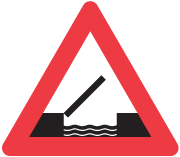
Warns that the bridge ahead may open for passing vessels and traffic may need to stop.
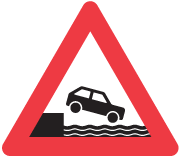
The sign indicates a ferry berth, wharf or similar. Besides at the normal distance, see Section 11, the sign can be set up on the edge of the wharf or similar.
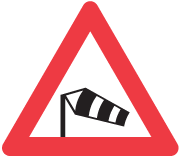
Warns that strong side winds may occur on the road ahead and may affect the stability of vehicles.
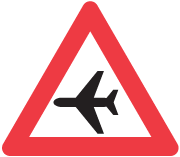
Low-flying aircraft.
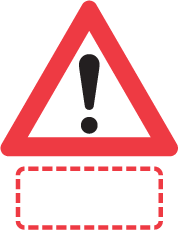
The sign indicates danger the type of which is shown on the plate under the warning sign. In connection with the plate below the sign with the text »Track«, the sign indicates crossing tracks where the road traffic is warned by personnel when the train is approaching, e.g. with a flag, signal lamp or manually operated flashing lights.